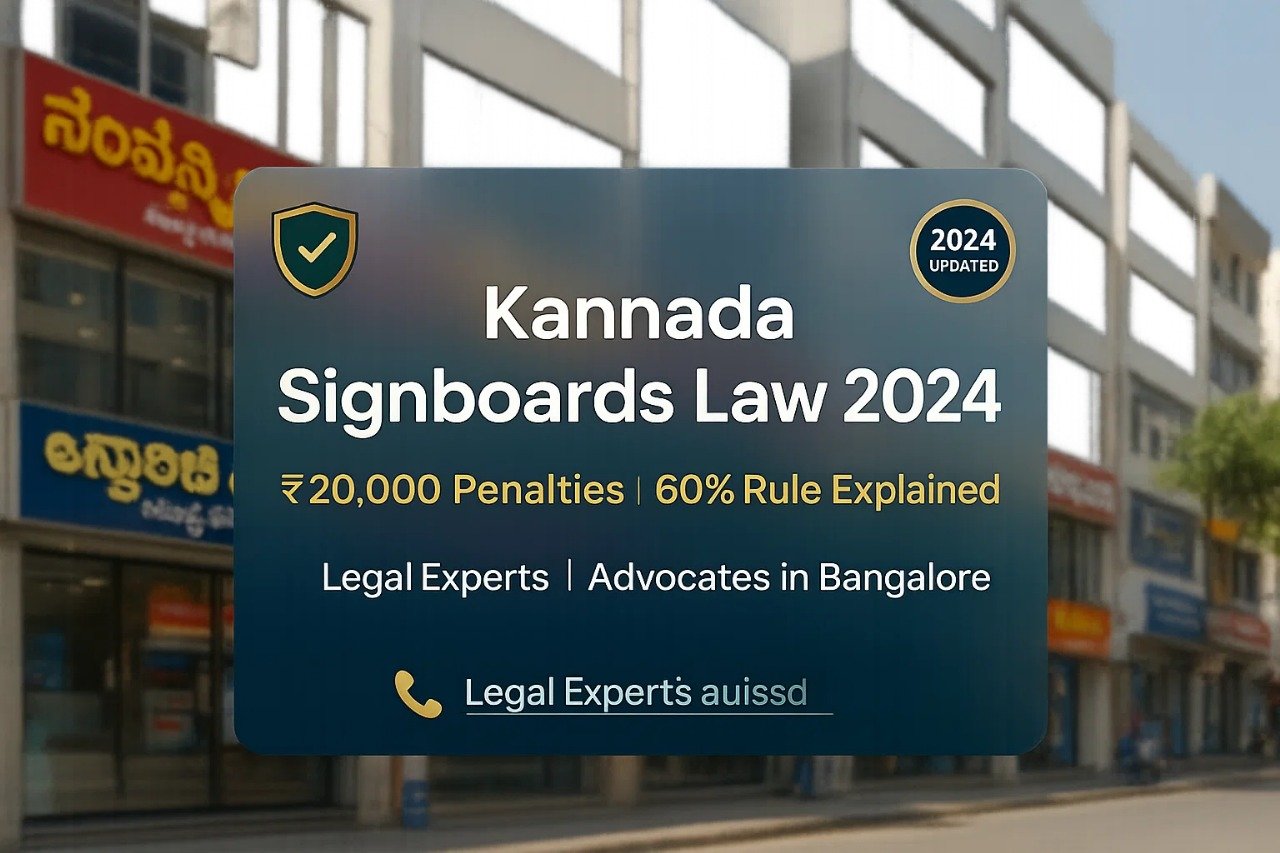
In December 2024, the Karnataka government made a decisive announcement that sent shockwaves through Bangalore’s business community: dedicated enforcement teams are now actively monitoring compliance with the Kannada Signboards Law in Karnataka across all commercial establishments. Over 50,000 commercial establishments in Bangalore alone have already received notices from BBMP (Bruhat Bengaluru Mahanagara Palike), and the numbers continue to climb.
The stakes have never been higher. Business owners in Vijaynagar, Rajajinagar, and across Bangalore face serious consequences, trade license denial, monetary penalties reaching ₹20,000, and potential business disruptions. What makes this particularly urgent is that many business owners still don’t fully understand the Kannada signboard law Bangalore requirements or believe they’re exempt from compliance.
At Advocates in Bangalore, we’ve successfully helped over 100 businesses navigate the Kannada Signboards Law in Karnataka without facing penalties. Our legal team has handled everything from BBMP notice responses to High Court writ petitions, giving us unique insights into what works and what doesn’t in compliance strategies.
This comprehensive guide will walk you through everything you need to know: the legal framework behind the BBMP Kannada signboard rule, the exact 60% requirement, step-by-step compliance procedures, penalty structures, and most importantly, when you need legal intervention to protect your business interests.
📞 Received a Notice? Don’t Wait- Call Advocates in Bangalore Now at +91-9886747301 for Free Legal Consultation
What is the Kannada Language Comprehensive Development Act?
The legal foundation for mandatory Kannada signboards stems from the Kannada Language Comprehensive Development Act, 2022 (Karnataka Act 13 of 2023), which was significantly strengthened through the Kannada Language Comprehensive Development (Amendment) Act, 2024 that came into force on February 26, 2024.
Section 17(6) of this amendment specifically mandates that all commercial signboards must display content with 60% Kannada prominence. This isn’t merely a suggestion or guideline, it’s legally binding legislation with enforceability backed by the Karnataka state government.
The law applies comprehensively to:
-
Commercial establishments (retail shops, supermarkets, stores)
-
Industrial units and manufacturing facilities
-
Business undertakings of all sizes
-
Trusts and charitable organizations with public-facing operations
-
Hospitals, clinics, and diagnostic laboratories
-
Hotels, resorts, and hospitality businesses
-
Amusement centers and recreational facilities
-
Counseling centers and educational institutions
-
Professional service offices (law firms, accounting firms, consultancies)
Understanding this legal framework is crucial because the Kannada Signboards Law in Karnataka is not temporary or experimental, it’s permanent state legislation with constitutional backing under the state’s authority to promote and preserve its official language.
The 60% Kannada Rule Explained
The 60 percent Kannada signboard rule operates on a specific 60:40 ratio breakdown that many business owners misunderstand. Here’s what compliance actually requires:
Critical Requirements:
-
60% Kannada Content: At minimum, 60% of your signboard’s text content must be in Kannada script
-
40% Other Languages: The remaining 40% can be in English, Hindi, or any other language
-
Upper Half Positioning: This is where most violations occur, Kannada text MUST occupy the upper, more prominent portion of the signboard
-
Font Size Parity: Kannada fonts must be equally or more prominent in size compared to other languages
-
Complete Information: All business details (name, nature of business, registration information) must appear in Kannada
The law applies to ALL signage types:
-
Exterior shop name boards
-
Display boards and hoardings
-
Nameplates and building identification signs
-
Directional signage within premises
-
Window displays with business names
Expert Insight from Advocates in Bangalore:
“Many business owners misunderstand the 60% rule. It’s not just about size, Kannada must occupy the upper, more prominent position on your signboard. We’ve seen cases where businesses had 60% Kannada at the bottom and still received notices. The positioning requirement is non-negotiable under current enforcement practices.”
— Senior Advocate, Advocates in Bangalore
Who Must Comply with the Kannada Signboard Law in Karnataka?
The short answer: everyone operating a commercial establishment in Karnataka must comply, regardless of business size, revenue, or ownership structure.
Businesses Required to Comply:
Retail and Commercial:
-
Retail shops and stores (clothing, electronics, grocery)
-
Supermarkets and hypermarkets
-
Street-facing vendor stalls with permanent structures
-
Shopping malls and commercial complexes
Food and Hospitality:
-
Restaurants, cafes, and fast-food outlets
-
Bars and liquor establishments
-
Hotels, resorts, and guest houses
-
Catering services with physical locations
Corporate and Professional:
-
Corporate offices (including MNC branches)
-
IT companies and software development centers
-
Professional service firms (law, accounting, consulting)
-
Co-working spaces and business centers
Healthcare:
-
Hospitals and nursing homes
-
Clinics and diagnostic centers
-
Pharmacies and medical stores
-
Dental and specialized care facilities
Education and Services:
-
Educational institutions and coaching centers
-
Gyms, fitness centers, and yoga studios
-
Salons, spas, and beauty parlors
-
Automobile service centers and workshops
Real Estate and Property:
-
Commercial property name boards
-
Real estate project signages
-
Residential complexes with commercial activities
-
Rental properties with business operations
No Exemptions Currently Exist
Currently, there are NO exemptions based on:
-
Business size or employee count
-
Annual revenue or turnover
-
Years of operation
-
Ownership type (individual, partnership, company)
-
Foreign investment or MNC status
Penalties and Consequences: What Happens If Your Shop Does Not Have a Kannada Signboard
Official Penalty Structure (2024-2025)
In December 2024, Karnataka’s Kannada & Culture Minister Shivaraj Tangadagi announced the official penalty structure that’s now being actively enforced:
Monetary Penalties:
-
First Offense: ₹5,000 fine
-
Second Offense: ₹10,000 fine
-
Subsequent Violations: ₹20,000 per violation
These aren’t theoretical penalties, enforcement teams are issuing challans and collecting fines across Karnataka’s urban centers.
Additional Legal Consequences
Beyond monetary fines, non-compliance with the Kannada Signboards Law in Karnataka triggers several serious administrative consequences:
1. Trade License Denial/Suspension
The most impactful consequence: businesses cannot obtain or renew trade licenses without submitting geotagged photographs of compliant Kannada signboards. This effectively prevents:
-
New business registrations
-
Annual license renewals
-
License modifications or updates
-
Expansion approvals
2. BBMP Notice Issuance
BBMP zonal offices issue compliance notices with extremely tight deadlines, typically 3 to 7 days for full compliance. Missing these deadlines triggers escalated enforcement actions.
3. Sealing Threats (Limited by Court Stay)
While the Karnataka High Court’s March 2024 stay order prevents immediate business sealing, enforcement continues through other administrative mechanisms. The stay is temporary and could be lifted.
4. Disciplinary Action Against Property Owners
Mall owners, commercial complex managers, and landlords face their own penalties if they don’t enforce tenant compliance.
5. Business Reputation Risks
Pro-Kannada activist groups have vandalized non-compliant establishments in the past, creating both financial damage and reputational harm.
Real Case Example
In January 2024, BBMP issued over 2,000 compliance notices across Hubballi zones alone. Businesses that failed to comply within the stipulated 7-day period faced stern administrative action including suspension of business operations.
CRITICAL UPDATE (December 2024): The Karnataka government has deployed dedicated enforcement teams with hired vehicles for statewide monitoring. A dedicated office for the monitoring cell is now fully operational.
How to Comply with the Kannada Signboard Rule in Karnataka: Step-by-Step Guide
Step 1: Audit Your Current Signboards
Start with a comprehensive signage audit:
-
Identify ALL signboards on your premises:
-
Primary exterior shop name board
-
Secondary exterior signage (side walls, back entrances)
-
Interior signage visible from public areas
-
Directional signs
-
Window displays with business information
-
-
Assess current compliance levels:
-
Measure Kannada percentage (count characters or measure space)
-
Check positioning (is Kannada in upper half?)
-
Evaluate font size comparison
-
Verify readability and clarity
-
-
Document everything with photographs, you’ll need baseline documentation and these photos will be useful for your geotagging requirements later.
Step 2: Design Compliant Signboards
Work with a qualified signboard designer who understands the BBMP Kannada signboard compliance checklist:
Design Specifications:
-
60:40 Ratio Template: Kannada occupies the upper 60% vertical space, with other languages in the lower 40%
-
Font Recommendations: Use clear, standard Kannada fonts like:
-
Nudi (official Karnataka government font)
-
Tunga
-
Kedage
-
Avoid decorative or stylized fonts that reduce legibility
-
-
Content Requirements: Include ALL business information in Kannada:
-
Business name
-
Nature of business/services offered
-
Registration/license numbers (where applicable)
-
Contact information
-
Practical Tip: Many signboard designers in Vijaynagar and Rajajinagar now offer specialized “Kannada compliance packages” ranging from ₹2,000 to ₹8,000 depending on board size, material quality, and complexity. Compare quotes from 3-4 vendors before finalizing.
Step 3: Install New Signboards
Professional installation ensures durability and compliance:
-
Hire certified vendors: Check BBMP’s approved vendor lists (available at zonal offices)
-
Use durable materials: Weather-resistant materials prevent fading and deterioration
-
Acrylic sheets with vinyl lettering: ₹3,000-₹6,000
-
LED-backlit boards: ₹8,000-₹15,000
-
Metal/aluminum boards: ₹5,000-₹12,000
-
-
Verify visibility: Signboards must be clearly visible from public roads and thoroughfares
-
Quality check before final payment:
-
Is Kannada in the upper half? ✓
-
Is font size adequate and readable? ✓
-
Are all details included? ✓
-
Is installation secure? ✓
-
Step 4: Take Geotagged Photographs
This step is mandatory for trade license applications and renewals.
How to Take Compliant Geotagged Photos:
-
Enable GPS/Location Services:
-
Android: Settings > Location > Turn ON
-
iPhone: Settings > Privacy > Location Services > Camera > While Using App
-
-
Take Clear External Photos:
-
Show complete signboard with business entrance
-
Ensure good lighting (daytime preferred)
-
Include surrounding landmarks for verification
-
Take from multiple angles
-
-
Verify Geotag Metadata:
-
Check photo properties for GPS coordinates (latitude/longitude)
-
Most smartphones embed this automatically when location is enabled
-
-
Critical Warning: DO NOT edit photos after capture, editing removes GPS metadata
-
Take Internal Photos (some applications require interior documentation)
Step 5: Submit Documentation to Authorities
Final compliance requires proper documentation submission:
-
Upload to BBMP Trade License Portal:
-
Create/login to your BBMP account
-
Navigate to trade license section
-
Upload geotagged photographs
-
Submit compliance declaration
-
-
If You’ve Received a Notice:
-
Respond within 3-7 days (as specified in notice)
-
Include proof of compliance (installation invoices, photographs)
-
Submit through proper channels (zonal office or online portal)
-
Expert Insight from Advocates in Bangalore:
“We recommend businesses maintain physical copies of all compliance documentation including geotagged photos, installation invoices, and submission receipts. These become critical evidence if disputes arise or if you need to challenge penalties. Digital backups on cloud storage provide additional security.”
Karnataka High Court Rulings & Current Legal Status
March 2024 Landmark Stay Order
In March 2024, the Karnataka High Court issued a crucial directive that shaped current enforcement practices. Justice M Nagaprasanna, hearing a petition from the Retailers Association of India, observed that certain enforcement provisions appeared “prima facie untenable” and directed the state government not to take precipitative action against businesses, specifically preventing immediate sealing of premises.
Key Court Observations:
The High Court’s interim order highlighted several concerns:
-
The implementation timeline was too aggressive for widespread compliance
-
Sealing businesses could cause disproportionate economic harm
-
Enforcement should focus on compliance assistance rather than punitive action
-
Administrative processes (like trade license linking) were more appropriate than sealing
Retailers Association of India Petition
The Retailers Association of India challenged implementation aspects, arguing that:
-
Many national brands couldn’t immediately redesign corporate signage standards
-
Small businesses lacked resources for immediate compliance
-
Enforcement should be educational initially, not punitive
Legal Status (December 2024)
Here’s what business owners need to understand about the legal landscape:
Stay on Sealing Remains: Businesses cannot be immediately sealed for non-compliance
Other Enforcement Continues:
-
Monetary penalties (₹5,000-₹20,000) are being actively imposed
-
Trade license denial/suspension continues
-
BBMP notices are still being issued
Compliance Still Mandatory: Despite court cases, the law remains in full effect and compliance is required for all administrative approvals
Government’s Firm Position: The Kannada & Culture Minister confirmed in December 2024 that penalties will be enforced without compromise
What This Means for Your Business
Practical Implications:
-
You won’t face immediate sealing, but you will face other significant consequences
-
Compliance is still mandatory for trade license processing
-
Legal challenges are ongoing, but don’t provide exemption from compliance requirements
-
Proactive compliance is recommended over waiting for favorable court outcomes
Case Law Reference:
In the matter of Retailers Association of India v. State of Karnataka (2024), the Karnataka High Court extended interim protection but made explicitly clear that compliance with signboard requirements remains obligatory for administrative approvals like trade licenses.
Legal Help for Kannada Signboard Law Violations: When Do You Need a Lawyer?
Situations That Require Legal Assistance
Not every compliance scenario requires legal representation, but these situations absolutely do:
1. Notice Received from BBMP/Deputy Commissioner
When you receive an official notice with tight 3-7 day deadlines, you need proper legal response drafting. Incorrect responses can escalate penalties or create admission of violations.
2. Trade License Denied or Suspended
Administrative appeals to licensing authorities require legal representation and understanding of administrative law procedures.
3. Penalty Imposed (Challenge Needed)
If you believe the penalty is:
-
Disproportionate to the alleged violation
-
Based on incorrect facts or measurements
-
Imposed without proper notice or hearing rights
Legal challenge may reduce or eliminate the penalty.
4. Threatened with Business Closure
Despite court stays, if authorities threaten closure, immediate legal intervention through writ petitions may be necessary.
5. Multiple Violations Across Locations
Businesses with 5+ locations facing simultaneous notices need coordinated legal strategy and bulk compliance planning.
6. Language Barrier Issues
Non-Kannada speaking business owners often misunderstand notice requirements, legal translation and clarification prevents costly mistakes.
7. Activist Pressure or Vandalism
If your business faces threats or actual vandalism from activist groups, legal protection orders and police complaint assistance become essential.
How Advocates in Bangalore Can Help
Our specialized legal services for the Kannada Signboards Law in Karnataka include:
Our Kannada Signboard Law Services:
-
Free Initial Consultation (15 minutes) to assess your situation
-
Notice Response Within 24 Hours for urgent compliance deadlines
-
Trade License Appeal Representation before Deputy Commissioners and BBMP authorities
-
Compliance Documentation Support including review of signboard designs and geotagged photos
-
Court Representation if writ petitions or legal challenges become necessary
-
Penalty Negotiation Services to reduce fines or extend timelines
-
Preventive Legal Audits for multi-location businesses to avoid violations
-
Fixed-Fee Packages for SMEs making legal help affordable
Client Success Story:
“A Vijaynagar-based retail chain with 5 outlets received simultaneous BBMP notices with 5-day compliance deadlines. Our legal team immediately negotiated a 30-day compliance extension, coordinated bulk signboard installation across all locations, and helped them avoid ₹50,000+ in potential penalties through proper documentation and timely legal responses.”
— Case Study, Advocates in Bangalore
DON’T FACE PENALTIES ALONE:
Call Advocates in Bangalore Now (24/7 Emergency)
Visit Our Google Business Profile (See Our Reviews)
Get Directions to Our Vijayanagar Office
Email: anjankumar5328@gmail.com
Common Mistakes Businesses Make (And How to Avoid Them)
Mistake #1: Placing Kannada in the Lower Half
What goes wrong: Many businesses achieve 60% Kannada coverage but place it in the bottom portion of their signboard.
Why this leads to rejection: The law specifically requires Kannada in the upper, more prominent position, not just 60% anywhere on the board.
Correct approach: Always design top-down, Kannada occupies the upper 60% vertical space, other languages below.
Mistake #2: Ignoring Notice Deadlines
What businesses overlook: BBMP notices provide only 3-7 days for compliance response.
Why delays are dangerous: Missing deadlines triggers automatic escalation to penalty imposition and potential trade license suspension.
Best practice: Respond immediately upon receiving any notice. If compliance isn’t possible within the deadline, file for extension through proper legal channels.
Mistake #3: Using Poor Quality or Unreadable Fonts
A common design error: Decorative, stylized, or overly artistic Kannada fonts that reduce legibility.
Why enforcement officers reject them: Enforcement officers reject signboards where Kannada isn’t clearly readable to average Kannada speakers.
Recommended solution: Use standard, government-approved Kannada fonts (Nudi, Tunga, Kedage) with clear, simple styling.
Mistake #4: Thinking Small Businesses Are Exempt
A widespread misconception: Assuming the law only applies to large establishments or corporate businesses.
The legal reality: The Kannada Signboards Law in Karnataka applies to ALL commercial establishments regardless of size, revenue, or employee count.
What this means for you: Comply regardless of business scale, even single-employee businesses need compliant signboards.
Mistake #5: Not Taking Proper Geotagged Photos
Where applications fail: Editing photos after capture or disabling GPS, which removes geotag metadata.
Why BBMP rejects such submissions: Trade license portals verify GPS coordinates, photos without geotags are rejected.
How to avoid rejection: Enable GPS before photographing, use original unedited photos, and verify metadata before submission.
Mistake #6: Delaying Compliance Hoping Law Will Change
What some businesses hope for: Waiting for High Court rulings or assuming enforcement will ease.
Why this strategy backfires: Despite court cases, enforcement through fines and license denial continues aggressively. December 2024 saw escalated enforcement.
Smart move: Comply now while monitoring legal developments separately. Compliance protects your business regardless of future court outcomes.
Kannada Signboard Law for Different Business Types
For Startups and New Businesses
Compliance Strategy:
-
Incorporate Kannada signboard requirements from day 1 during shop setup
-
Budget ₹3,000-₹10,000 for compliant signage in initial setup costs
-
Get compliance right during initial trade license application, avoid rework
Advantage: New businesses can design compliance into their branding from inception without retrofitting costs.
For Retail Chains and Franchises
Compliance Strategy:
-
Standardize compliant Kannada signboard templates across all Karnataka locations
-
Establish centralized compliance team or designate compliance officer
-
Negotiate bulk vendor contracts for cost efficiency across multiple outlets
Special Consideration: Corporate branding guidelines may need Karnataka-specific variations to accommodate 60% Kannada requirements.
For Corporate Offices and MNCs
Compliance Strategy:
-
Apply rules to ALL signages: building names, directional boards, department signs, reception areas
-
Compliance officer should conduct quarterly audits
-
Include signboard compliance in corporate governance checklist
Budget Consideration: Larger premises may require 10-20 compliant signboards (₹30,000-₹1,50,000 total investment).
For Property Owners and Landlords
Compliance Strategy:
-
Ensure tenant compliance through lease agreement clauses
-
Property name boards (building names) must comply
-
Commercial complex owners: enforce compliance across all tenant units
Legal Liability: Landlords can face penalties if they don’t enforce tenant compliance in commercial properties.
For Restaurants, Cafes, and Hospitality
Compliance Strategy:
-
Menu boards visible from outside must have Kannada
-
Interior signages are covered if visible to public
-
Hotel name boards on buildings are enforcement priority
Additional Requirement: Some hospitality businesses may need Kannada on directional signage (restrooms, exits, etc.).
Frequently Asked Questions (FAQs)
1. What is the Kannada signboards law in Karnataka?
The Kannada Signboards Law in Karnataka refers to the Kannada Language Comprehensive Development (Amendment) Act, 2024, which mandates that all commercial establishments display 60% of their signboard content in Kannada language. The Kannada text must be positioned in the upper half of the signboard, with the remaining 40% allowed in any other language. This law applies to all businesses, industries, hospitals, hotels, and commercial undertakings operating in Karnataka.
2. What is the penalty for not having a Kannada signboard in Karnataka?
As per the December 2024 announcement by Karnataka’s Kannada & Culture Minister, penalties for non-compliance are: ₹5,000 for the first offense, ₹10,000 for the second offense, and ₹20,000 for each subsequent violation. Additionally, businesses may face trade license denial or suspension, as geotagged photos of compliant Kannada signboards are now mandatory for license renewal.
3. Is the 60% Kannada rule mandatory in Bangalore?
Yes, the 60 percent Kannada signboard rule is mandatory across all of Karnataka, including Bangalore. BBMP (Bruhat Bengaluru Mahanagara Palike) actively enforces this rule through zonal offices, issuing notices to non-compliant businesses and requiring geotagged signboard photos for trade license processing.
4. Do I need geotagged photos of my Kannada signboard?
Yes, geotagged photographs of your compliant Kannada signboard are now mandatory for trade license applications and renewals in Karnataka. You must enable GPS/location services on your smartphone camera, take clear photos showing the complete signboard and establishment entrance, and ensure the metadata contains latitude/longitude coordinates. Avoid editing photos as it removes geotag data.
5. What happens if my shop does not have a Kannada signboard?
If your shop does not have a Kannada signboard, you may face: (1) Monetary penalties ranging from ₹5,000 to ₹20,000 depending on offense count, (2) Denial or suspension of trade license renewal, (3) Issuance of legal notices from BBMP zonal offices with 3-7 day compliance deadlines, (4) Potential disciplinary action, and (5) Possible activist pressure. The Karnataka High Court stay prevents immediate sealing but other enforcement measures continue.
6. How can I comply with the Kannada signboard rule in Karnataka?
To comply: (1) Design a new signboard with 60% Kannada text in the upper half and 40% other language below, (2) Use clear, readable Kannada fonts like Nudi or Tunga, (3) Hire authorized signboard vendors for installation, (4) Take geotagged photographs with GPS enabled on your smartphone, (5) Upload photos to BBMP trade license portal, and (6) Submit compliance documentation to your zonal office. Maintain copies of all documentation including installation invoices and submission receipts.
7. Why is Kannada mandatory on signboards in Karnataka?
Kannada is mandatory on signboards to promote and preserve the state’s official language, ensure linguistic inclusivity, and enable Kannada-speaking residents to easily identify and access businesses. The Kannada Language Comprehensive Development Act aims to give prominence to Kannada in public spaces while allowing businesses to use other languages in the remaining 40% space.
8. Does the Kannada signboard law apply to small businesses?
Yes, the Kannada Signboards Law in Karnataka applies to ALL commercial establishments regardless of size, including small shops, home-based businesses with commercial signage, street vendors with permanent boards, and micro-enterprises. There are currently no exemptions based on business size, revenue, or employee count.
9. Can I challenge a Kannada signboard penalty notice?
Yes, you can challenge a Kannada signboard penalty notice through legal channels. Options include: (1) Filing a response to BBMP explaining compliance or seeking extension, (2) Appealing to the Deputy Commissioner, (3) Filing a writ petition in Karnataka High Court if your rights are violated. However, it’s advisable to first consult a lawyer experienced in Karnataka administrative law. Advocates in Bangalore provides specialized representation for signboard-related legal matters.
10. Where can I get legal help for Kannada signboard law in Vijaynagar, Bangalore?
Advocates in Bangalore, located in Vijaynagar, specializes in Kannada signboard law compliance and litigation. They provide services including notice response, trade license appeals, compliance documentation, penalty challenge, and court representation. Contact them at +91-9886747301 for a free initial consultation to understand your legal options and compliance requirements specific to your business type and location.
Conclusion: Take Action Today to Protect Your Business
The December 2024 enforcement escalation makes one thing abundantly clear: the Kannada Signboards Law in Karnataka is not going away. With dedicated enforcement teams, operational monitoring cells, and penalties reaching ₹20,000 per violation, the consequences of non-compliance have never been more serious.
Yet here’s the encouraging reality, with proper guidance, compliance is straightforward and affordable. Most businesses in Vijaynagar and across Bangalore achieve full compliance for ₹3,000-₹10,000 and avoid all penalties entirely. The Kannada signboard law Bangalore requirements, while specific, are not insurmountable obstacles.
At Advocates in Bangalore, we’ve successfully guided hundreds of businesses through this process. Whether you’re facing a BBMP notice with a looming deadline, planning proactive compliance for new business setup, or need legal defense against disproportionate penalties, our experienced legal team is here to help.
Your business is your livelihood. Don’t let a signboard technicality derail years of hard work. Take action today.
Don’t navigate the Kannada Signboards Law in Karnataka alone. Whether you need emergency legal response to a notice, comprehensive compliance planning, or High Court representation, Advocates in Bangalore delivers results-focused legal solutions tailored to your business needs.
I am Anjan Kumar, the founder of Advocates in Bangalore, a trusted law firm with over 15 years of legal experience and 12,000+ satisfied clients across Bangalore and Karnataka. Specializing in criminal law, divorce law, property disputes, and corporate legal matters, we handle High Court, District Court, and Family Court cases with professionalism and tailored solutions.
Our team has successfully represented 12,000+ clients, earning a reputation as trusted advocates in Bangalore. We operate 24/7, providing expert legal guidance and strong court representation.
At Advocates in Bangalore, we believe in honest communication, ethical practices, and results. We’re here to protect your rights with integrity.
For legal consultation: contact us at anjankumar5328@gmail.com | Call: +91-9886747301