When a First Information Report (FIR) is registered against you, the immediate concern is often whether it can be challenged or cancelled, especially if you believe it to be false or malicious. FIR quashing in Bangalore is a legal remedy available through the Karnataka High Court that allows individuals to seek dismissal of criminal proceedings under specific circumstances.
This guide explains what FIR quashing means, the legal grounds on which it can be sought, the process involved at the Karnataka High Court, and when you should consider consulting a lawyer. Whether you are facing allegations arising from personal disputes, business conflicts, or what you believe to be frivolous complaints, understanding your legal options is the first step toward informed decision-making.
Need Urgent Help? Don’t Wait.
📞 Call Advocates in Bangalore: +91-9886747301
1-Minute Read Summary
FIR quashing is a legal remedy through which the Karnataka High Court can dismiss criminal proceedings initiated by an FIR. It is sought under Section 482 of the Criminal Procedure Code when the allegations are found to be false, absurd, constitute a civil dispute, or there has been a settlement between parties in compoundable offences. The process involves filing a criminal petition before the High Court, presenting legal arguments, and seeking dismissal of the FIR or charge sheet. The timeline varies depending on case complexity, but generally may take anywhere from a few months to over a year. Legal representation by an experienced advocate is crucial as the matter involves technical legal arguments and constitutional powers of the High Court.
What Is FIR Quashing in Bangalore and Why Is It Used?
What is FIR quashing in Bangalore refers to the legal process where the High Court of Karnataka exercises its inherent powers to dismiss or nullify a First Information Report and any subsequent criminal proceedings arising from it. This power is granted under Section 482 of the Criminal Procedure Code (CrPC), which allows the High Court to pass orders necessary to prevent abuse of the court process or secure the ends of justice.
People approach the High Court for FIR quashing rather than police authorities because once an FIR is registered, the police are bound to investigate the matter as per legal procedure. The police cannot simply “cancel” an FIR on request. Only a court of competent jurisdiction, in this case, the High Court, has the authority to examine whether the criminal proceedings should continue or be quashed.
FIR quashing is used when:
-
The allegations do not constitute a criminal offence
-
The FIR is filed with malicious intent or to settle scores
-
The matter is essentially civil in nature but cloaked as a criminal complaint
-
Parties have reached a settlement in compoundable offences
-
Continuing the proceedings would be an abuse of the legal process
Can a False FIR Be Cancelled Through FIR Quashing?
Yes, a false FIR can be cancelled through the quashing process if you can demonstrate to the High Court that the allegations are baseless, malicious, or do not disclose any cognizable offence. However, it’s important to understand that the court will not conduct a detailed trial at this stage.
The High Court examines the allegations as stated in the FIR and related documents to see if they prima facie (on the face of it) constitute an offence under law. If the allegations, even if taken as true, do not make out any criminal offence, or are so absurd that no reasonable person would believe them, the court may quash the FIR.
There are limits to this power. The court will generally not quash an FIR where:
-
Disputed questions of fact need detailed investigation
-
The allegations, if proven, would constitute a serious criminal offence
-
The investigation is still at an early stage and prematurely stopping it would harm justice
The Supreme Court has clarified that misuse of criminal law, such as using criminal complaints to pressurize someone in a purely civil dispute, can be grounds for quashing.
What Is the Difference Between FIR Quashing and Discharge?
Understanding the difference between FIR quashing and discharge helps you choose the correct legal remedy at the right stage.
FIR Quashing:
-
Sought before or during the early stages of a criminal case
-
Filed in the High Court under Section 482 CrPC
-
Aims to stop the entire criminal proceeding at the threshold
-
Can be sought even before chargesheet is filed
Discharge:
-
Sought after chargesheet has been filed and charges are framed
-
Filed before the Trial Court (Magistrate or Sessions Court)
-
Aims to get the accused released from the specific charges
-
Comes at a later stage in the criminal process
In simple terms, quashing stops the case from progressing further at the High Court level, while discharge is a remedy during trial when the trial court finds insufficient evidence to proceed with charges.
Which Court Has Jurisdiction to Quash an FIR in Bangalore?
Jurisdiction to quash an FIR in Bangalore lies with the High Court of Karnataka. Specifically, petitions are filed before the Bengaluru Bench of the Karnataka High Court, which handles criminal matters arising within its territorial jurisdiction.
The power to quash FIRs is derived from:
-
Section 482 of the Criminal Procedure Code – which grants inherent powers to the High Court to prevent abuse of process and secure justice
-
Article 226 of the Constitution – which empowers High Courts to issue writs for enforcement of fundamental rights
Lower courts, including Magistrate Courts and Sessions Courts, do not have the inherent powers to quash an FIR under Section 482. This is why engaging a High Court lawyer familiar with criminal jurisdiction is important for such matters.
What Are the Legal Grounds for FIR Quashing Under Section 482 CrPC?
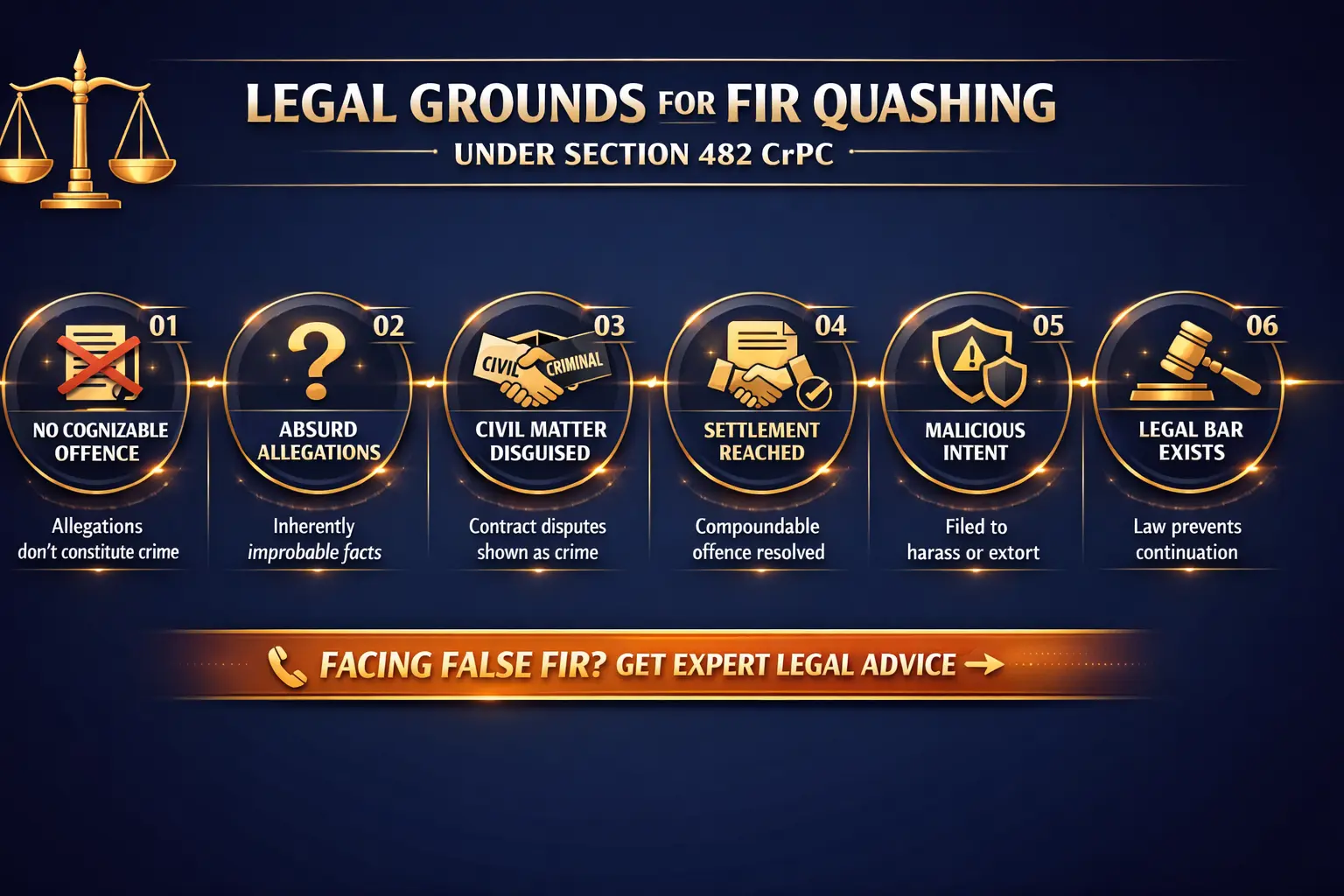
The grounds for FIR quashing under Section 482 have been established through various Supreme Court judgments. The High Court may quash an FIR or criminal proceedings when:
1. No cognizable offence is made out:
The allegations in the FIR, even if accepted at face value, do not constitute any offence under the Indian Penal Code or other criminal laws.
2. Allegations are absurd or inherently improbable:
The facts stated are so absurd that no reasonable person would believe them or conclude there is ground for proceeding.
3. Civil dispute disguised as criminal case:
The matter is essentially a civil dispute (contract breach, money recovery, property disagreement) but has been falsely presented as a criminal matter.
4. Settlement between parties in compoundable offences:
When parties have amicably resolved the matter and the offence is compoundable under law.
5. Malicious prosecution or abuse of process:
The FIR has been filed with mala fide intention to harass, extort, or settle personal scores.
6. Legal bar to continuation:
There is a specific legal provision that bars continuation of such proceedings.
These grounds are not exhaustive. Each case is examined on its own facts, and the court exercises discretion based on justice, equity, and prevention of abuse.
How Does the FIR Quashing Process Work in Bangalore High Court?
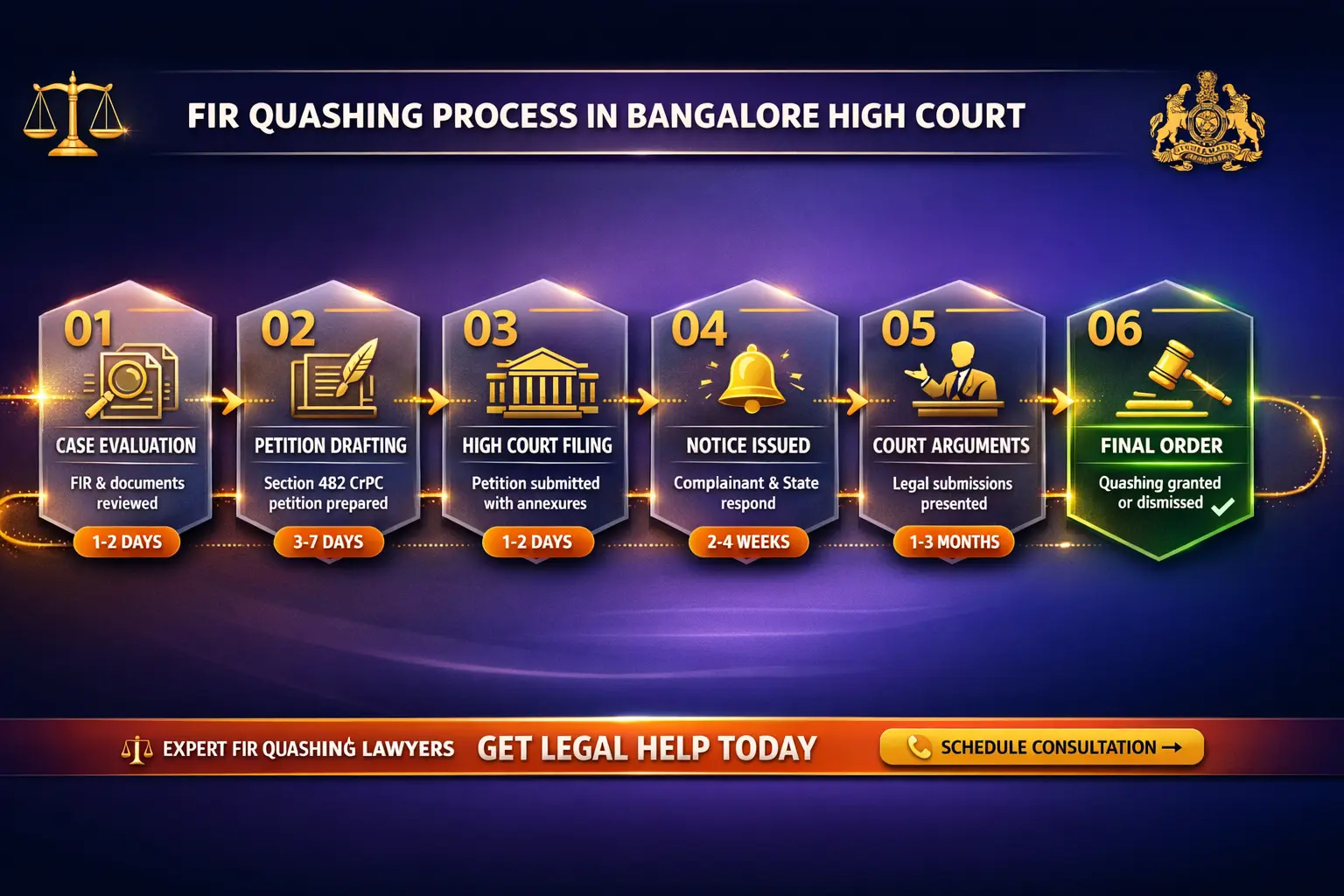
The FIR quashing process in Bangalore High Court generally follows these steps:
Step 1: Case Evaluation
Your advocate reviews the FIR, complaint, and any documents to assess whether the case qualifies for quashing under established legal grounds.
Step 2: Drafting the Petition
A Criminal Petition is prepared under Section 482 CrPC, detailing the facts, legal grounds, and precedents supporting your case. A detailed synopsis is attached explaining why quashing is justified.
Step 3: Filing in High Court
The petition is filed before the Karnataka High Court along with supporting documents, affidavits, and the case diary (if available).
Step 4: Notice and Response
The court issues notice to the opposing party (complainant and State). They file their response opposing or supporting the quashing.
Step 5: Arguments
Your counsel presents arguments on absence of offence, abuse of process, settlement, or other grounds. The court examines applicable Supreme Court and Karnataka High Court precedents.
Step 6: Court Order
The court may:
-
Quash the FIR/proceedings fully or partially
-
Dismiss the petition
-
Give conditional orders (e.g., settlement to be executed before trial court, no coercive action)
The process requires strict adherence to procedural requirements and persuasive legal arguments rooted in established jurisprudence.
Can FIR Be Quashed Before Chargesheet Is Filed?
Yes, an FIR can be quashed before chargesheet is filed. In fact, many petitions are filed at this stage to prevent unnecessary investigation and potential arrest.
The High Court has the power to examine the allegations at the FIR stage itself and determine whether allowing the investigation to continue would serve any purpose or would amount to abuse of process. If the court is satisfied that the allegations are prima facie false, vexatious, or do not constitute any offence, it may quash the FIR even before police complete the investigation.
However, the court will exercise this power cautiously. If the allegations involve serious offences or disputed facts requiring investigation, the court may allow the investigation to proceed and advise seeking quashing after the chargesheet if warranted.
Timing can be strategic. Filing early may stop harassment, but courts also consider whether sufficient opportunity has been given for investigation.
How Long Does FIR Quashing Take in High Court?
The question of how long FIR quashing takes in High Court does not have a fixed answer, as the timeline depends on several factors:
Factors affecting duration:
-
Complexity of the case and nature of allegations
-
Court’s pending workload and hearing schedule
-
Whether the matter requires detailed examination of documents
-
Response time from the opposing party and State
-
Whether interim relief (stay on arrest/investigation) is sought
-
Number of hearings required for final arguments
Based on general observations, the process may take anywhere from a few months to over a year. Some straightforward cases may be resolved in 2 to 5 hearings spanning 10 days to 3 months, while complex matters, especially in cases like Section 498A, may take 1 to 2 years.
It is important to have realistic expectations. The court’s priority is ensuring justice, not speed. Your advocate can provide a more specific assessment based on the particulars of your case and current High Court timelines.
What Happens After an FIR Is Filed Against You in Bangalore?
Understanding what happens after an FIR is filed against you helps reduce panic and enables you to take informed steps.
Immediate legal consequences:
-
Police are legally bound to investigate the allegations mentioned in the FIR
-
You may be called for questioning during the investigation
-
Depending on the nature of the offence (bailable or non-bailable), police may seek your arrest
-
The investigation may include collection of evidence, witness statements, and documentation
Your rights:
-
You have the right to legal representation at all stages
-
In bailable offences, you have the right to bail
-
In non-bailable offences, you can approach court for bail or anticipatory bail
-
You can file for FIR quashing if grounds exist
What you should do:
-
Consult a criminal lawyer immediately to understand the allegations and legal options
-
Do not ignore summons or police notices
-
Preserve any evidence that supports your case
-
Avoid making statements without legal advice
An FIR does not mean automatic guilt or conviction. It is the starting point of investigation, and you have constitutional rights and legal remedies available at every stage.
How Can a False FIR Be Quashed in Bangalore Legally?
To understand how to quash a false FIR in Bangalore legally, you need to demonstrate to the High Court that the case fits within recognized quashing grounds.
Documentation required:
-
Copy of the FIR and complaint
-
Any evidence proving the allegations are false
-
Settlement documents (if applicable)
-
Previous correspondence showing the civil nature of dispute
-
Affidavits supporting your version
Petition drafting:
Your advocate will draft a detailed criminal petition under Section 482 CrPC explaining:
-
The factual background
-
Why the allegations are false or do not constitute an offence
-
Legal precedents supporting quashing
-
Prayer for quashing the FIR and all related proceedings
Court scrutiny:
The court will examine whether:
-
The allegations make out a prima facie criminal offence
-
Investigation or prosecution would serve any purpose
-
Continuing proceedings would amount to abuse of process
-
There are disputed questions of fact requiring trial
The success of quashing depends on the strength of your legal arguments, supporting evidence, and how well your case aligns with established legal principles.
When Should You Consult a FIR Quashing Lawyer in Bangalore?
Knowing when to consult a FIR quashing lawyer in Bangalore can make a significant difference in how your case progresses.
You should consider legal consultation when:
-
You have received information that an FIR has been filed against you
-
You believe the allegations are false, exaggerated, or motivated by malice
-
The complaint arises from a civil or commercial dispute being misrepresented as criminal
-
You are being pressured to settle a monetary dispute through criminal threats
-
Parties are willing to settle but the FIR continues
-
You face potential arrest or harassment due to the FIR
-
The allegations could harm your professional or personal reputation
Early consultation helps because:
-
You can explore anticipatory bail if the offence is non-bailable
-
Timely filing may prevent prolonged investigation and harassment
-
Strategic legal steps can be planned from the beginning
-
Evidence can be preserved and documented properly
Legal matters involving criminal allegations should not be handled without professional guidance, as procedural errors can have serious consequences.
Which Situations Require Legal Help for False FIR in Bangalore?
Certain situations particularly require legal help for false FIR in Bangalore due to their complexity or potential consequences:
1. False or malicious complaints:
When the FIR is clearly motivated by personal vendetta, business rivalry, or to extract money, legal intervention is necessary to protect your rights and prevent misuse of criminal law.
2. Compromise-based disputes:
In matrimonial disputes, cheque bounce cases, or other matters where parties have reached an amicable settlement, a lawyer can facilitate quashing through proper legal channels.
3. Corporate or professional exposure:
Business owners, directors, and professionals facing criminal allegations related to contracts, GST, or corporate disputes need specialized legal representation to prevent damage to reputation and business operations.
4. Cases involving serious allegations:
When serious offences are alleged, even if they are false, the stakes become high. Professional legal defense becomes essential to navigate the complexities of criminal procedure.
What Does a High Court Lawyer for FIR Quashing Actually Do?
A High Court lawyer for FIR quashing provides specialized legal services at various stages:
Case analysis:
Reviews the FIR, complaint, evidence, and applicable law to assess the viability of quashing. Advises on realistic outcomes and alternative remedies if quashing is not feasible.
Petition drafting:
Prepares a legally sound criminal petition under Section 482 CrPC with detailed grounds, factual synopsis, legal precedents, and supporting documents.
Court representation:
Argues the case before the High Court and presents clear legal submissions explaining why the FIR should be quashed. Responds to arguments from the prosecution and complainant.
Procedural compliance:
Ensures compliance with all procedural requirements by filing within the correct jurisdiction, submitting proper documentation, following High Court rules, and responding to court queries on time.
Interim relief:
If needed, seeks urgent interim orders such as stay on arrest, stay on investigation, or protection from coercive action during the pendency of the petition.
The role of an advocate for FIR quashing petition is not just about filing documents but about strategically navigating the legal process to achieve the best possible outcome for the client.
Which FIR Quashing Legal Services Are Offered by Advocates in Bangalore?

Advocates in Bangalore provides comprehensive FIR quashing legal services in Bangalore for individuals and corporate entities facing criminal allegations. The scope of assistance includes:
Legal consultation:
Initial assessment of your case, explanation of legal options, realistic evaluation of quashing prospects, and guidance on next steps.
Petition preparation and filing:
Drafting of criminal petition under Section 482 CrPC, compilation of supporting documents, affidavits, and filing before Karnataka High Court.
Court representation:
Experienced advocates argue your case before the High Court, present legal precedents, and respond to objections from the prosecution.
Settlement facilitation:
In cases where parties wish to settle, assistance in drafting settlement agreements and presenting them to court for quashing based on compromise.
Follow-up and compliance:
Ensuring proper implementation of court orders and obtaining certified copies of quashing orders for record.
When you hire an advocate for FIR quashing, you benefit from professional legal representation that understands both the substantive criminal law and the procedural nuances of High Court practice. Legal services tailor their approach to the specific facts of each case, and courts decide outcomes based on merits and judicial discretion, without any guaranteed results.
Call Advocates in Bangalore Now (24/7 Emergency)
Visit Our Google Business Profile (See Our Reviews)
Get Directions to Our Vijayanagar Office
Email: anjankumar5328@gmail.com
Frequently Asked Questions About FIR Quashing in Bangalore
Q1. Can FIR quashing stop police investigation completely?
Yes, if the High Court quashes the FIR, the police investigation stops immediately and all proceedings arising from that FIR are nullified. However, if the court only stays the investigation or gives conditional directions, the investigation may resume based on court orders.
Q2. Is FIR quashing possible after chargesheet is filed?
Yes, FIR quashing is possible even after the chargesheet has been filed. The High Court can examine the charge sheet and quash the proceedings if it finds that continuing the prosecution would be an abuse of process or that the allegations do not constitute an offence. However, the court may require stronger grounds when the investigation is complete.
Q3. Can FIR quashing be rejected by the High Court?
Yes, the High Court can reject the quashing petition if it finds that the allegations, if proven, would constitute a cognizable offence, or if disputed questions of fact require trial, or if quashing would not serve the ends of justice. Rejection does not mean guilt, it only means the criminal proceedings will continue through the normal trial process.
Q4. Do I need a criminal lawyer consultation for FIR quashing?
Yes, a criminal lawyer consultation for FIR quashing is strongly advisable. FIR quashing involves technical legal arguments, knowledge of criminal procedure, understanding of High Court precedents, and strategic decision-making. Attempting to navigate this process without legal expertise may result in procedural errors or missed opportunities for relief.
Q5. Is FIR quashing applicable in corporate criminal disputes?
Yes, FIR quashing applies to corporate criminal disputes, especially when parties falsely portray civil or commercial disagreements as criminal offences. Cases involving contract breaches, payment disputes, or business disagreements often qualify for quashing if they do not genuinely involve criminal intent or offence.
Conclusion
FIR quashing in Bangalore is an important legal remedy that protects individuals and businesses from wrongful criminal prosecution and abuse of legal process. The Karnataka High Court can quash FIRs under Section 482 CrPC, but it evaluates each case based on its specific facts, legal grounds, and consistency with established judicial principles.
If you face a false or malicious criminal complaint, understanding your legal options is crucial. The quashing process requires careful legal strategy, proper documentation, and effective court representation.

I am Anjan Kumar, the founder of Advocates in Bangalore, a trusted law firm with over 15 years of legal experience and 12,000+ satisfied clients across Bangalore and Karnataka. Specializing in criminal law, divorce law, property disputes, and corporate legal matters, we handle High Court, District Court, and Family Court cases with professionalism and tailored solutions.
Our team has successfully represented 12,000+ clients, earning a reputation as trusted advocates in Bangalore. We operate 24/7, providing expert legal guidance and strong court representation.
At Advocates in Bangalore, we believe in honest communication, ethical practices, and results. We’re here to protect your rights with integrity.
For legal consultation: contact us at anjankumar5328@gmail.com | Call: +91-9886747301