Finding out that a First Information Report (FIR) has been registered, whether you are the complainant seeking justice or the person named in the document, often brings a wave of anxiety and questions. The legal system can seem opaque, and misunderstandings about police procedures frequently lead to unnecessary panic or missed opportunities to protect your rights. An FIR is not a conclusion; it is merely the beginning of the criminal investigation process.
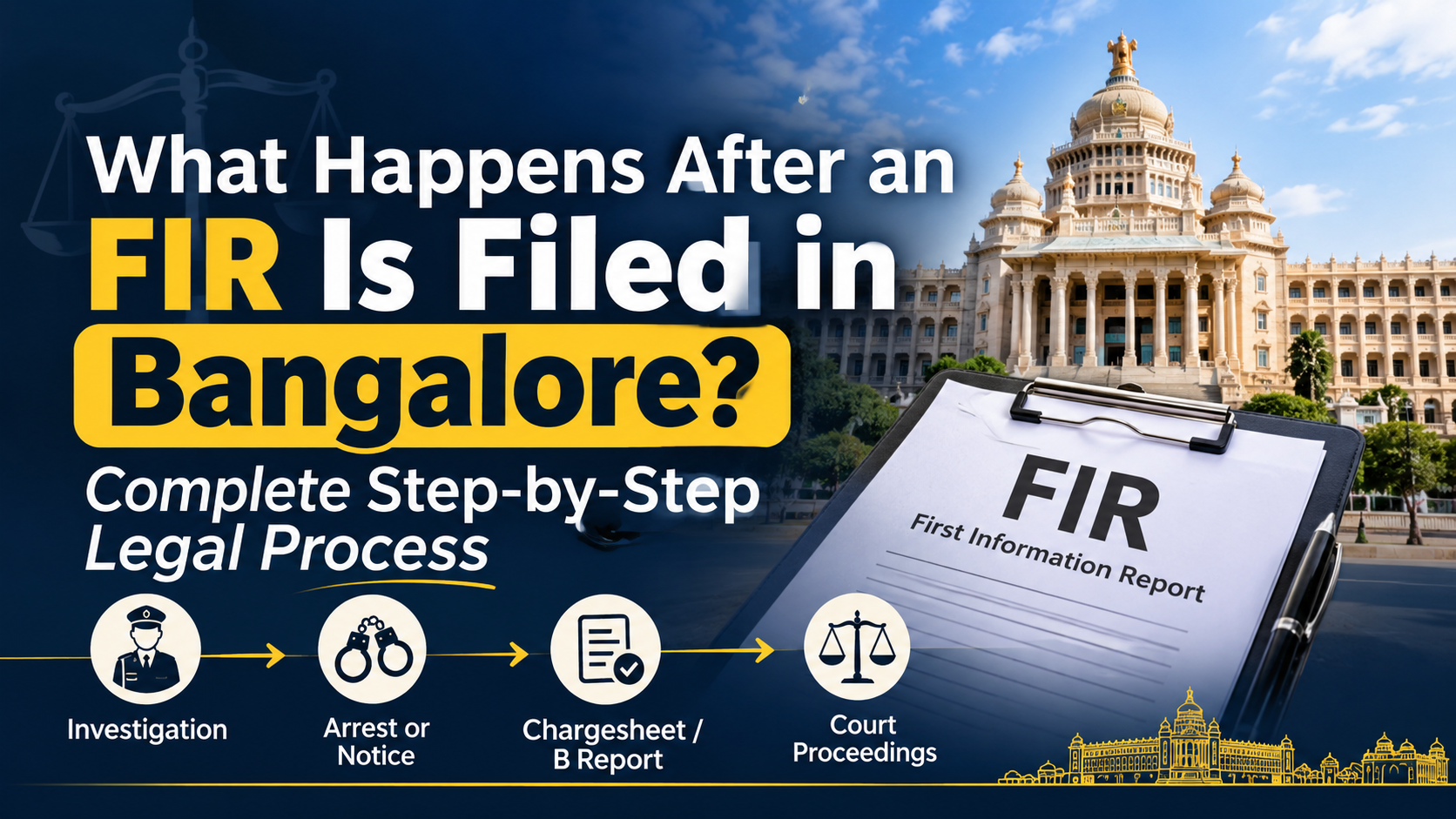
Once an FIR is registered, the police are legally bound to investigate the allegations, collect evidence, and eventually submit a final report to the competent court. Depending on the nature of the alleged offence and the evidence gathered, the accused may receive a notice to appear or face arrest. The investigation may conclude with a chargesheet to initiate a trial, or a closure report if the allegations lack sufficient evidence.
Discuss Your FIR Case With Kumar & Anjan Law Associates: call +91-9886747301.
Visit Our Office:XGJQ+346, 103, 4th Main Rd, opposite Indian oil petrol pump, Govindaraja Nagar, Vijayanagar, Bengaluru, Karnataka 560040
Google Maps: Check Our Google My Business Listing for Reviews
Quick Answer: The 4-Step Process After an FIR
-
Investigation Begins: The police assign an Investigating Officer (IO) to examine the crime scene, gather evidence, and record witness statements.
-
Notice or Arrest: Based on the offence’s severity and legal requirements, the police may issue a notice for questioning or, if statutory conditions are met, execute an arrest.
-
Police Report Filed: Once the investigation concludes, the police submit a report to the Magistrate, either a chargesheet (to prosecute) or a closure report (to drop the case).
-
Court Proceedings: The court reviews the police report, takes cognizance if appropriate, and dictates the subsequent legal steps, moving toward a trial or discharge.
What Happens Immediately After an FIR Is Registered in Bangalore?
Under Section 173 of the Bharatiya Nagarik Suraksha Sanhita (BNSS), 2023, information relating to a cognizable offence is recorded as an FIR. This formal documentation officially sets the criminal justice machinery into motion. Immediately after the FIR is registered, the jurisdictional police station takes up the matter for investigation.
The informant or victim is legally entitled to receive a free copy of the FIR immediately. This document contains crucial details, including the Crime Number (FIR number), the specific police station, and the sections of the law invoked. Both parties need this information to track the case’s progress, respond to police communications, or seek legal remedies in the Karnataka High Court or the local sessions court.
It is important to clarify that registering an FIR does not automatically trigger an immediate arrest, a dramatic police raid, or a fixed 24-hour timeline for solving the case. Instead, the station house officer evaluates the information and assigns the case to an Investigating Officer (IO), who will map out the necessary investigative steps based on the facts and the applicable law.
How Does the Police Investigation Process Work After an FIR?
The police investigation is the core phase that determines whether a case will proceed to trial. Governed primarily by Sections 175 and 176 of the BNSS, the investigation aims to uncover the truth of the allegations through lawful evidence collection.
Appointment of the Investigating Officer
The Station House Officer (SHO) appoints an Investigating Officer to lead the case. The IO is responsible for examining the allegations, identifying the involved parties, and deciding the sequence of investigative actions. The IO acts as the primary point of contact for both the complainant and the accused during this phase, ensuring that the investigation complies with procedural laws.
Collection of Evidence and Witness Statements
The IO undertakes a systematic process to gather facts. Depending on the nature of the crime, this may include:
-
Visiting and securing the alleged place of occurrence to draw a spot mahazar (scene of crime report).
-
Collecting physical documents, digital records, CCTV footage, and financial transactions.
-
Conducting searches and seizures when legally authorized under Section 185 of the BNSS.
-
Sending recovered items for forensic or medical examination and reviewing expert reports.
-
Recording the statements of individuals acquainted with the facts of the case.
Can the Police Call the Complainant or Witnesses for Questioning?
Yes, under Section 180 of the BNSS, the police have the authority to require the attendance of witnesses, including the complainant, who appear to be acquainted with the facts of the case. If you are called, you are expected to cooperate and provide truthful information. However, answering police questions is distinct from a formal statement recorded by a Magistrate. The IO will draft a written record of your statement, which forms a crucial part of the case diary and the eventual final report submitted to the court.
Can Police Arrest You After an FIR Is Filed?
The fear of sudden arrest is the most common concern for anyone named in an FIR. However, the law provides specific guidelines that the police must follow, balancing the need for effective investigation with the fundamental rights of the individual.
Does an FIR Automatically Lead to Arrest?
Registration of an FIR does not automatically require or justify an arrest. Section 35 of the BNSS strictly governs when a police officer may arrest a person without a warrant. The police must apply statutory conditions, evaluating whether an arrest is genuinely necessary to prevent the person from committing further offences, tampering with evidence, threatening witnesses, or fleeing from justice. Arrest is an investigative tool, not an immediate punishment for being named in a complaint.
When Can Police Issue a Notice Instead of Making an Arrest?
For offences where the law does not mandate an immediate arrest, the police often utilize the notice-of-appearance procedure under Section 35(3) of the BNSS. This notice directs the accused person to appear before the investigating officer at a specified time and place.
It is vital to distinguish between a notice and an arrest:
-
Receiving a notice: You are asked to cooperate with the investigation. If you comply with the notice and cooperate, you generally cannot be arrested unless the police record specific reasons justifying the arrest.
-
Being arrested: You are taken into formal custody, depriving you of your liberty.
-
Being in custody: You are held by the police (police custody) or in jail under a court order (judicial custody).
Do not assume that the police can never arrest someone for an offence punishable by up to seven years in prison. Section 35 contains conditions and exceptions; if the IO believes the accused is destroying evidence or refusing to cooperate, an arrest can still be legally executed.
What Happens If a Person Is Arrested?
When the police determine that an arrest is necessary and lawful, specific procedures must be followed to safeguard the arrested individual’s rights:
-
The police must communicate the specific grounds for the arrest.
-
The arrested person has the right to inform a designated relative or friend about their detention.
-
The police must produce the arrested individual before a Magistrate without unnecessary delay, ordinarily within 24 hours (excluding journey time).
-
During interrogation, the arrested person has the right to consult an advocate of their choice, though the advocate cannot be present throughout the entire interrogation.
Individuals anticipating an arrest may seek anticipatory bail. Once someone is already in custody, their legal counsel will apply for regular bail. Consulting an experienced criminal defense attorney at Kumar & Anjan Law Associates is critical at this juncture to secure your liberty.
What Are Your Legal Rights After an FIR Is Registered?
Being named in an FIR simply means someone has made an allegation against you; it does not mean you have been convicted, nor does it prove that the allegations are true. The law affords several protections to individuals facing criminal accusations:
-
Right to Legal Representation: You have the fundamental right to consult and be defended by a legal practitioner of your choice.
-
Right Against Self-Incrimination: You cannot be compelled to be a witness against yourself or forced to confess.
-
Right to Know the Grounds of Arrest: If arrested, you must be informed immediately of the reasons for your arrest and whether the offence is bailable.
-
Right to Seek Bail: Depending on whether the alleged offence is bailable or non-bailable, you have the right to apply for bail through the appropriate court.
-
Right to Fair Investigation: You are entitled to due process. The investigation must be conducted fairly, without bias, and in accordance with statutory procedures.
-
Right to Meet an Advocate: Under Section 38 of the BNSS, an arrested person has the right to meet an advocate during interrogation.
What Should You Do After an FIR Is Filed?
The steps you take immediately after an FIR is registered can significantly impact the outcome of the case. Your actions will depend on whether you are the accused or the complainant.
If You Are the Person Named in the FIR
-
Obtain the FIR: Secure a copy of the FIR through lawful channels, either by applying to the court or checking online portals if the FIR is not sealed or sensitive.
-
Understand the Charges: Review the specific BNSS or other penal sections mentioned. Identify whether the offences are bailable or non-bailable.
-
Preserve Evidence: Immediately secure relevant text messages, emails, transaction records, location history, and any documents that support your defense. Do not delete anything.
-
Comply with Notices: Do not ignore a lawful police notice or summons. Ignoring a notice to appear can be used as grounds to justify your arrest.
-
Seek Legal Counsel: Consult a criminal lawyer immediately to discuss whether you need to apply for anticipatory bail, cooperate with the notice, or seek to quash the FIR under Section 528 of the BNSS in the Karnataka High Court.
If You Are the Complainant or Victim
-
Secure the Details: Keep your free copy of the FIR and the crime number safely. You will need this for all future references.
-
Organize Your Evidence: Gather and preserve all supporting documents, medical records, or digital evidence, and provide them to the IO.
-
Submit Information Formally: When providing additional information or evidence to the police, ensure you maintain a record or acknowledgement of your submission.
-
Follow Up Lawfully: Stay in touch with the IO to track the progress of the case. Under Section 193 of the BNSS, the police are required to inform the informant or victim about the progress of the investigation within 90 days.
-
Seek Remedies for Inaction: If the police stall the investigation or act with bias, consult an advocate to pursue legal remedies that ensure a proper inquiry.
What Happens After the Police Investigation Is Completed?
An FIR investigation does not go on forever. Once the IO has gathered all available evidence, recorded statements, and concluded the inquiry, they must submit a final police report to the competent Magistrate under Section 193 of the BNSS. This report takes one of two forms.
When the Police File a Chargesheet
If the IO concludes that there is sufficient evidence and material to proceed against the accused, they will file a chargesheet. This comprehensive document details the alleged offences, the particulars of the accused, a list of witnesses, and the collected evidence.
It is crucial to remember that filing a chargesheet merely indicates that the police believe there is enough evidence to warrant a trial. It does not establish guilt. The burden of proof remains on the prosecution to prove the charges beyond a reasonable doubt in a court of law.
What Is a Closure Report or B Report?
If the police investigation reveals that the allegations are false, that the dispute is purely civil in nature, or that there is insufficient evidence to prosecute, the IO will submit a closure report. In Bangalore and across Karnataka, this is commonly referred to as a “B Report.”
When a B Report is filed:
-
The court reviews the police findings.
-
The Magistrate will issue a notice to the complainant, giving them an opportunity to object to the closure.
-
The complainant can file a “Protest Petition” challenging the police’s conclusion and presenting reasons why the case should proceed.
-
The law does not force the Magistrate to accept the B Report blindly; if they find merit in the protest petition, the judge can reject the closure report, take cognizance of the offence, or order further investigation.
What Happens After a Chargesheet Is Filed in Court?
Filing a chargesheet transitions the case from the investigative stage to the judicial stage. However, the case does not instantly jump to witness cross-examination the very next day.
-
Taking Cognizance: The competent court reviews the chargesheet. If the Magistrate finds sufficient grounds, they take cognizance of the offence.
-
Supply of Documents: The court ensures that the accused receives copies of the chargesheet, witness statements, and all relied-upon documents, ensuring a fair opportunity to prepare a defense.
-
Arguments on Charge: The court will hear arguments from both sides. If the judge finds no sufficient ground to proceed, the court may discharge the accused at this stage.
-
Framing of Charges: If a prima facie case exists, the court formally frames the charges, reads them to the accused, and asks whether they plead guilty or claim a trial.
-
Trial Initiation: The actual trial begins only after the court formally frames the charges, proceeding based on whether the case is Magistrate-triable or Sessions-triable.
For a detailed understanding of the complete judicial journey, refer to our comprehensive guide on the Criminal Case Process in Bangalore.
How Long Does the FIR Investigation and Criminal Case Take?
There is no universal, fixed deadline that guarantees every FIR investigation will be concluded in 30, 60, or 90 days. The duration depends entirely on the nature and complexity of the offence, the number of accused persons, the availability of witnesses, and the time required to obtain expert forensic or digital evidence reports.
You may have heard of a 60-day or 90-day rule. It is important to contextualize this correctly. Section 187(3) of the BNSS governs the maximum period an accused can be kept in custody during an investigation. If the police fail to file a chargesheet within 90 days (for offences punishable by death, life imprisonment, or 10+ years) or 60 days (for other offences), the accused in custody gains an indefeasible statutory right to “default bail.” This is a custody limit, not a law stating that the investigation itself must legally terminate after 90 days.
What If the Police Do Not Investigate the FIR Properly?
In some cases, the police register the FIR but then stall the investigation, ignore the complainant, or fail to gather crucial evidence. The law provides specific escalation routes for aggrieved informants.
-
Record Your Follow-Ups: Always maintain written records of your visits and submissions to the investigating officer.
-
Approach Senior Officers: Under Section 173(4) of the BNSS, if you are aggrieved by inaction, you may send the substance of your grievance to the Superintendent of Police (or the jurisdictional DCP in Bangalore), who can direct a proper investigation.
-
Approach the Court: If police inaction persists, you can file an application with the Magistrate under Section 175(3) of the BNSS to seek a judicial order directing the police to investigate the matter thoroughly.
While the law provides these established remedies, utilizing them requires proper drafting and representation. Consulting a legal professional ensures you present your grievances effectively to the court.
Frequently Asked Questions
1. Can police arrest me immediately after an FIR is registered? No, an FIR does not automatically mandate an immediate arrest. Under Section 35 of the BNSS, the police must evaluate if an arrest is strictly necessary to prevent evidence tampering, further offences, or the accused absconding. Often, a notice to appear is issued instead.
2. Can an FIR be withdrawn after it is registered? An FIR for a cognizable offence cannot simply be “withdrawn” at the police station by the complainant. Instead, the police must file a closure report, the parties can compound the offence if the law permits, or the High Court can quash the FIR under Section 528 of the BNSS.
3. How can I check the status of an FIR in Karnataka? You can check the status online through the Karnataka State Police (KSP) official portals or the e-Courts app by using the FIR number (Crime Number), police station name, and the year of registration.
4. Can I get a copy of an FIR filed against me? Yes. While the complainant gets an immediate free copy, the accused can obtain a certified copy by applying through their advocate at the jurisdictional Magistrate court, or download it from the police portal unless it is classified as a sensitive case.
5. What should I do if I receive a police notice after an FIR? Do not ignore it. A notice requires your cooperation with the investigation. Consult a criminal advocate immediately to understand your rights, prepare your documents, and determine if you need to apply for anticipatory bail before appearing.
Conclusion
An FIR is the starting line of a criminal investigation, not a final declaration of guilt or innocence. The subsequent steps, ranging from evidence collection and police notices to the filing of a chargesheet or a B Report, depend heavily on the facts of the case, the applicable laws, and the decisions of both the investigating agency and the court. Whether you are seeking justice as a complainant or defending yourself against allegations, understanding your statutory rights and following proper legal procedure is paramount. If you are navigating a criminal case, reach out to the experienced legal team at Kumar & Anjan Law Associates to secure the right representation.

I am Anjan Kumar, the founder of Advocates in Bangalore, a trusted law firm with over 15 years of legal experience and 12,000+ satisfied clients across Bangalore and Karnataka. Specializing in criminal law, divorce law, property disputes, and corporate legal matters, we handle High Court, District Court, and Family Court cases with professionalism and tailored solutions.
Our team has successfully represented 12,000+ clients, earning a reputation as trusted advocates in Bangalore. We operate 24/7, providing expert legal guidance and strong court representation.
At Advocates in Bangalore, we believe in honest communication, ethical practices, and results. We’re here to protect your rights with integrity.
For legal consultation: contact us at anjankumar5328@gmail.com | Call: +91-9886747301