If you or a loved one are facing criminal proceedings, or if you are a complainant seeking justice, understanding the Stages of a Criminal Trial in India is one of the most important steps you can take. A criminal case involves far more than just courtroom hearings; it is a multi-step journey that begins long before a judge hears the matter.
This guide breaks down the three broad phases of a criminal case: the pre-trial investigation, the actual trial, and the post-trial procedures. Under the present legal framework, the procedure is primarily governed by the Bharatiya Nagarik Suraksha Sanhita, 2023 (BNSS), while the rules of evidence and specific offences are addressed under the Bharatiya Sakshya Adhiniyam, 2023 (BSA) and the Bharatiya Nyaya Sanhita, 2023 (BNS) respectively. By knowing what to expect, you can navigate the legal system with greater confidence.
Discuss Your FIR Case With Kumar & Anjan Law Associates: call +91-9886747301.
Visit Our Office:XGJQ+346, 103, 4th Main Rd, opposite Indian oil petrol pump, Govindaraja Nagar, Vijayanagar, Bengaluru, Karnataka 560040
Google Maps: Check Our Google My Business Listing for Reviews
What Are the Main Stages of a Criminal Trial in India?
When people ask about the Stages of a Criminal Trial in India, it is helpful to look at the process in three main parts. A criminal case generally moves through three broad phases: pre-trial proceedings, the trial itself, and post-trial proceedings. These phases cover everything from the initial complaint or FIR and police investigation to court proceedings, evidence presentation, the final judgment, and available legal remedies like appeals.
Here is a simple overview table of the criminal trial process in India:
| Phase | What Happens |
| Pre-trial | FIR or complaint, investigation, police report, and initial court proceedings. |
| Trial | Charges or accusation, prosecution evidence, accused examination, defence, and arguments. |
| Post-trial | Judgment, sentencing where applicable, appeals, and execution. |
To clarify the legal terminology used in the Stages of a Criminal Trial in India:
-
Investigation: The evidence-gathering process conducted by the police.
-
Inquiry: A judicial examination of a matter by a Magistrate or court, other than a trial.
-
Trial: The formal court proceedings to determine the criminal liability of the accused.
Important: These three phases are a useful explanatory framework to help you understand the criminal trial process in India, not three formally named stages prescribed as such by the BNSS.
Phase 1 – What Happens Before a Criminal Trial Begins?
Before examining the courtroom Stages of a Criminal Trial in India, it is crucial to understand the pre-trial steps. The actions taken here set the foundation for the entire case.
1. Filing of an FIR or Criminal Complaint
The very first step is officially reporting the offence. A police case typically begins with the registration of a First Information Report (FIR) for a cognizable offence (serious crimes where police can arrest without a warrant).
Alternatively, a person may bypass the police and approach a Magistrate directly by filing a criminal complaint. The basic difference is that a police-report case relies on the police to investigate and file a final report, whereas, in a complaint case, the Magistrate conducts an initial inquiry to decide if there are sufficient grounds to proceed against the accused. The applicable provisions for this stage include Section 173 and Section 223 of the BNSS.
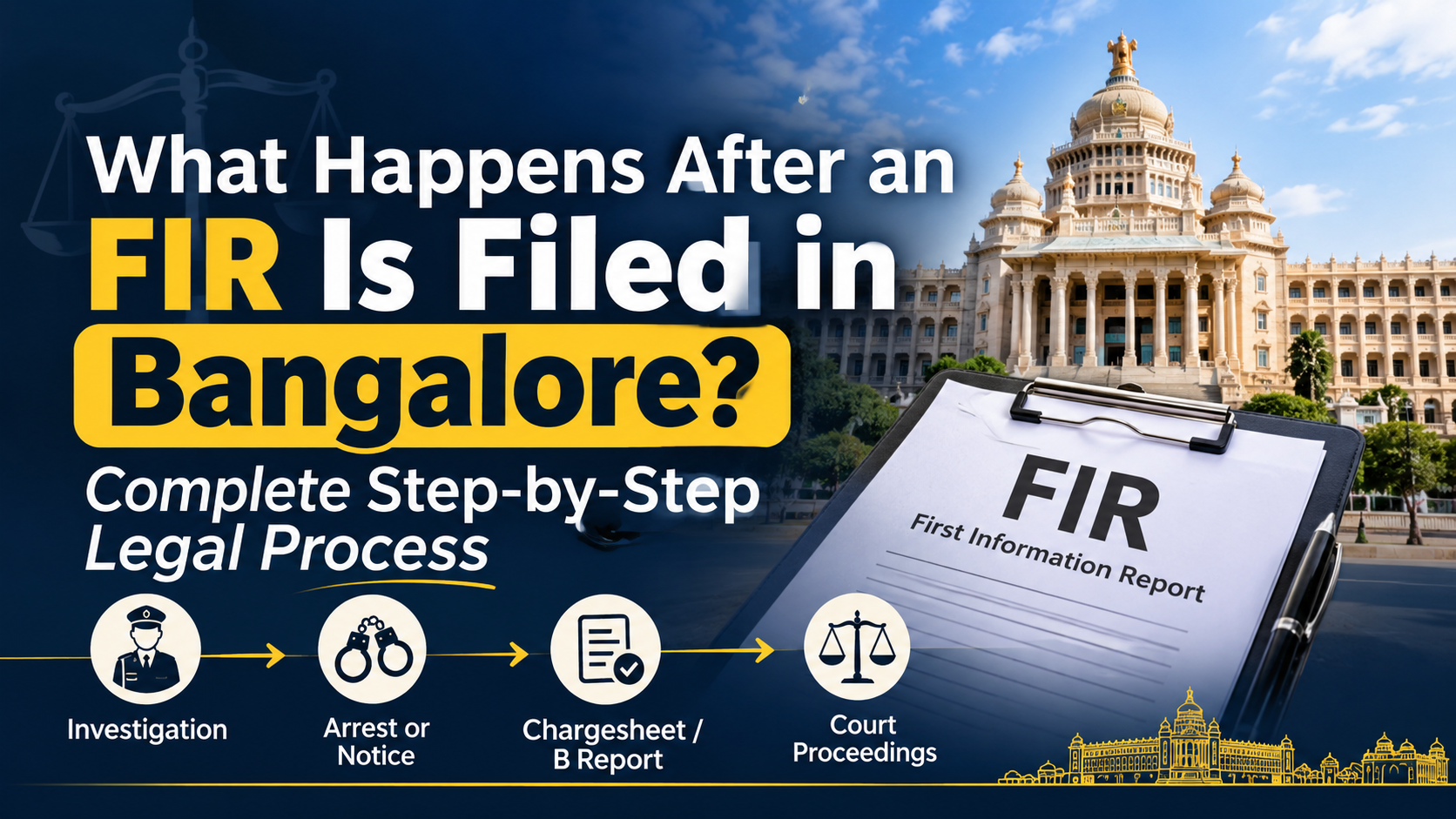
2. Police Investigation and the Role of the Accused
Once an FIR is filed, the police investigation begins. The investigating officer’s role is to collect evidence, visit the crime scene, seize relevant documents or items, and examine witnesses.
For the accused, this stage can be highly stressful. It is important to know that arrest is not always automatic. Depending on the circumstances and the gravity of the offence, the police may issue a notice of appearance. If an arrest is considered, the accused has the right to seek bail. The police are bound by legal procedures under Sections 35, 180, and 187 of the BNSS, as applicable, ensuring that the investigation is conducted fairly without unnecessary harassment.
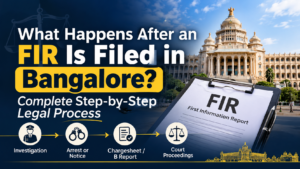
3. Filing of the Chargesheet or Closure Report
After completing the investigation, the police must submit a final police report to the Magistrate under Section 193 of the BNSS.
-
Chargesheet: If the police collect sufficient material and evidence against the accused, they file a chargesheet. It is crucial to note that filing a chargesheet simply means the police believe there is enough evidence to justify a trial; it does not itself establish guilt.
-
Closure Report: If the investigation reveals insufficient evidence, or if no offence is made out, the police file a closure report, requesting the court to close the case.
4. Cognizance, Court Process and Supply of Documents
When the Magistrate receives the chargesheet, they must apply their judicial mind to the facts. This is known as taking cognizance. Taking cognizance means the court has formally taken notice of the offence and decided to initiate judicial proceedings. It is different from framing charges, which happens later.
Upon taking cognizance under Section 210 of the BNSS, the Magistrate issues summons or warrants to compel the accused to appear in court. Once the accused appears, the court ensures they are supplied with free copies of the FIR, the police report, and all relevant documents under Section 230 BNSS. This guarantees that the accused knows exactly what they are facing before the next procedural steps begin.
5. Discharge or Framing of Charges
The final pre-trial step involves the court evaluating whether the trial should proceed.
-
Discharge: After reviewing the police report and documents, and hearing both sides, if the court considers that there is insufficient ground to proceed against the accused, it will discharge them. A discharge means the trial will not take place.
-
Framing of Charges: If there are grounds to presume the accused committed the offence, the court formally frames the charges. The charges are read and explained to the accused, informing them of the exact allegations they must answer. They are then asked if they plead guilty or claim to be tried.
The relevant law for this includes Sections 250–251 for Sessions trials and Sections 262–263 for relevant warrant cases instituted on a police report. Important: Not every case has a formal charge-framing stage; summons cases follow a different, simplified procedure.
Phase 2 – What Happens During a Criminal Trial in Court?
Once charges are framed and the accused pleads not guilty, the actual trial commences. This is the most crucial part of the Stages of a Criminal Trial in India, where the court determines innocence or guilt based on evidence. The exact procedure depends on the nature of the case and the specific court conducting the trial.
6. Opening of the Case and Prosecution Evidence
The courtroom Stages of a Criminal Trial begin with the opening of the case. In a state-prosecuted case, the Public Prosecutor represents the state and outlines the allegations and the evidence they intend to present.
The core principle of criminal jurisprudence in India is that the prosecution carries the burden of establishing guilt beyond a reasonable doubt. The prosecution presents its case by introducing oral witnesses and bringing documentary or electronic evidence on record. The procedures for this stage are outlined in provisions such as Section 254 BNSS for Sessions trials and Section 265 BNSS for relevant warrant cases instituted on a police report.
7. Examination and Cross-Examination of Witnesses
The presentation of evidence is one of the most critical and time-consuming Stages of a Criminal Trial in India. The Bharatiya Sakshya Adhiniyam, 2023 (BSA) governs how evidence is admitted and evaluated. The testimony of every witness generally goes through three basic parts:
-
Examination-in-chief: This is the initial questioning of the witness by the party that called them (usually the prosecution at this stage). The goal is to establish facts supporting their case.
-
Cross-examination: Following the chief examination, the defence lawyer aggressively questions the witness. The objective is to test the witness’s credibility, find contradictions, and dismantle the prosecution’s narrative.
-
Re-examination: If new issues or ambiguities arise during cross-examination, the party who originally called the witness may question them again to clarify those specific matters.
8. Examination of the Accused Under Section 351 BNSS
A unique and vital protective measure within the Stages of a Criminal Trial in India is the examination of the accused. After the prosecution finishes presenting its evidence, the court must personally question the accused under Section 351 of the BNSS.
The purpose is to give the accused an opportunity to explain any circumstances or incriminating evidence appearing against them in the prosecution’s case. It is a direct dialogue between the judge and the accused. It is important to note that this examination is not the same as giving sworn defence testimony. The accused cannot be cross-examined on these answers, and they are not administered an oath.
9. Defence Evidence
After the accused is examined, the court asks if they wish to lead any defence evidence.
The accused may choose to present relevant defence witnesses and documents to counter the prosecution’s claims, considered according to the applicable procedure. However, the law is clear: the accused is not generally required to prove their innocence simply because they are facing a criminal charge. The burden of proof remains on the prosecution.
Furthermore, under Section 353 BNSS, an accused person is a competent witness for the defence and may testify on oath, but only upon their own written request. If the accused chooses not to testify, their silence cannot legally be used to draw an adverse presumption against them.
10. Final Arguments
Once all evidence from both sides is recorded, the trial moves to final arguments.
The Public Prosecutor presents their final submissions, summarizing how the evidence proves the charges against the accused. The defence counsel then responds, pointing out flaws, contradictions, and legal loopholes in the prosecution’s case, while highlighting the defence evidence. Both sides address the court on the facts, the credibility of the evidence, and the applicable law, aiming to persuade the judge toward conviction or acquittal.
11. Pronouncement of Judgment
The courtroom Stages of a Criminal Trial in India conclude with the judgment. The judge carefully evaluates all the oral and documentary evidence, the witness testimonies, and the legal arguments presented by both sides.
The court will pronounce its final verdict: it may acquit the accused (declare them not guilty) or convict them (declare them guilty). A valid criminal judgment must provide the court’s clear findings and the detailed reasons behind its decision. If the judgment results in a conviction, the court will typically schedule a separate hearing to consider the appropriate sentence, allowing both sides to argue on the quantum of punishment before it is finalized.
Do All Criminal Cases Follow the Same Trial Procedure?
When exploring the Stages of a Criminal Trial in India, a common question is whether every case is tried the same way. The answer is no. The exact procedure depends on the severity of the offence, its classification, and the jurisdiction of the court conducting the trial.
Here are the main procedural distinctions under the BNSS:
| Type of Proceeding | Basic Explanation |
| Summons Case | A simplified Magistrate procedure typically for less serious offences; a formal charge-framing order is not strictly required. |
| Warrant Case | A more detailed Magistrate procedure for more serious offences, requiring formal charge-framing where the law requires it. |
| Sessions Trial | Formal proceedings before a Court of Session for severe offences (like murder or rape) exclusively triable by that higher court. |
| Summary Trial | A simplified and expedited procedure for specified minor cases, where permitted by law, to dispose of matters quickly. |
These are not four identical or mutually exclusive categories. For instance, a “Sessions trial” identifies both the court and the procedure, while a “summary trial” is a specific simplified mode of trial. The applicable procedure is dictated by the offence and statutory provisions, rather than a simplistic punishment threshold.
Phase 3 – What Happens After a Criminal Court Judgment?
The Stages of a Criminal Trial in India do not necessarily end when the trial court pronounces its judgment. Post-trial procedures dictate what happens next based on the outcome.
12. What Happens After Acquittal?
If the trial ends in acquittal, the accused is cleared of the charge and is released from custody (if they were in jail) or discharged from their bail bonds. The stigma of the criminal charge is legally removed. However, the complainant or the State may have the right to file an appeal against the acquittal in a higher court under appropriate circumstances.
13. What Happens After Conviction?
If the court convicts the accused, it must consider the appropriate sentence. The nature of the punishment (imprisonment, fines, or both) depends strictly on the specific offence as defined in the Bharatiya Nyaya Sanhita, 2023 (BNS) and the applicable law. Following the sentence, the convicted person has the right to explore statutory appellate remedies to challenge the decision.
14. Appeals, Revisions and Execution of Sentence
The final aspect of the Stages of a Criminal Trial in India involves challenging the verdict or executing it.
-
Appeal: A statutory remedy allowing the convicted person (or sometimes the State/complainant) to challenge the trial court’s decision in a higher court, subject to applicable conditions (covered under BNSS appeal provisions beginning at Section 413).
-
Revision: A narrower supervisory remedy where a higher court examines the legality or propriety of a lower court’s finding, available only in specified circumstances.
-
Execution: If no appeal is filed, or if appellate remedies are exhausted, the State implements the sentence according to the law.
(Note: Section 531 BNSS preserves the old CrPC procedure for proceedings that were already pending immediately before the BNSS came into force on July 1, 2024. This is highly important for readers following older, ongoing cases.)
How Long Does a Criminal Trial Take in India?
A very common query regarding the Stages of a Criminal Trial is how long the entire process takes. There is no single fixed duration for every criminal trial.
The timeline is affected by the complexity of the crime, the volume of evidence, the number of witnesses, court workload, adjournments, and procedural issues. However, the BNSS does contain specific time provisions to speed up certain stages. For example, Section 251 and Section 263 prescribe a 60-day period for framing charges in their respective applicable proceedings, calculated from the first hearing on charge.
Regarding judgments, Section 258 provides a 30-day judgment period for Sessions trials, extendable to 45 days with recorded reasons. Furthermore, Section 392 contains a general provision for pronouncing judgment in criminal courts of original jurisdiction, allowing no later than 45 days after the termination of the trial.
Critical distinction: You may hear about 60-day or 90-day deadlines regarding police investigations and default bail under Section 187 BNSS; these are deadlines for filing the chargesheet, not deadlines for completing the entire criminal trial.
Frequently Asked Questions
1. What are the stages of a criminal trial in India?
A criminal case moves through three main phases: pre-trial (FIR, investigation, and chargesheet), the trial itself (framing of charges, prosecution evidence, defence evidence, and arguments), and post-trial (judgment, sentencing, and appeals).
2. What happens after a chargesheet is filed in court?
Once the police file a chargesheet, the Magistrate takes cognizance of the offence. The court issues summons, supplies case documents to the accused, and hears arguments to decide whether to discharge the accused or frame charges for trial.
3. Is the accused always arrested before a criminal trial?
No, an arrest is not automatic. Depending on the gravity of the offence and the necessity of police custody, the police may issue a notice of appearance. The accused can also apply for anticipatory or regular bail to avoid imprisonment during the trial.
4. What is the difference between discharge and acquittal?
A discharge happens before the trial begins, when the judge finds insufficient grounds in the chargesheet to proceed. An acquittal happens at the very end of a full trial, where the judge evaluates all evidence and declares the accused not guilty.
5. Can a criminal court judgment be challenged in a higher court?
Yes. Whether it is a conviction or an acquittal, the aggrieved party generally has statutory remedies to challenge the trial court’s judgment by filing an appeal or a revision petition in a higher court, subject to legal conditions.
Conclusion
A criminal case is complex, moving through several connected procedural stages. As we have seen, the Stages of a Criminal Trial in India run from the initial police investigation all the way to the final courtroom judgment and potential appeals. The exact sequence can vary depending on the nature of the case, and understanding the applicable procedure helps an accused person, or a complainant, know exactly what to expect. While the BNSS, BNS, and BSA govern the present framework, navigating them requires experience.
If you are dealing with a criminal matter, Kumar & Anjan Kumar Law Associates, a Bangalore-based legal practice, offers experienced guidance. To understand how the law applies to your specific circumstances, you can consult their Criminal Case Process in Bangalore services for professional legal support.

I am Anjan Kumar, the founder of Advocates in Bangalore, a trusted law firm with over 15 years of legal experience and 12,000+ satisfied clients across Bangalore and Karnataka. Specializing in criminal law, divorce law, property disputes, and corporate legal matters, we handle High Court, District Court, and Family Court cases with professionalism and tailored solutions.
Our team has successfully represented 12,000+ clients, earning a reputation as trusted advocates in Bangalore. We operate 24/7, providing expert legal guidance and strong court representation.
At Advocates in Bangalore, we believe in honest communication, ethical practices, and results. We’re here to protect your rights with integrity.
For legal consultation: contact us at anjankumar5328@gmail.com | Call: +91-9886747301